
There is a white oak on the corner of a residential street in my town that has been there for somewhere around 160 years. I know this because the county historical society put up a small placard near its base a few years ago, right around the time the neighboring property changed hands and the new owners nearly had it cut down to make room for a patio expansion.
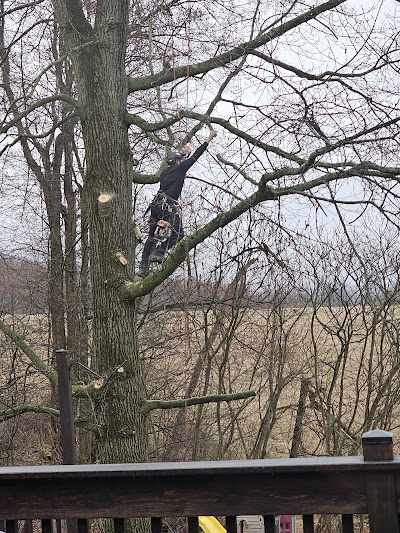
They did not cut it down. A neighbor intervened. The tree service that came out to assess it instead ended up pruning it, cabling two of its heavier lateral branches, and treating a small area of bark decay near the root flare. The tree is still standing.
I think about that oak often when I am working on residential properties. Not because it is dramatic or unusual, but because it quietly illustrates something most property owners never get the chance to learn: the trees that survive for generations do not survive by accident.
Which raises an uncomfortable question about the way most people actually treat the trees on their property.
Most people think of tree care as reactive. Something falls, something looks sick, something is in the way of a fence line. You call someone, they come out, the problem gets addressed. That is how the majority of homeowners and property managers interact with the trees on their land, and it is not entirely their fault. Nobody hands you a tree maintenance manual when you close on a house.
But here is what that model misses: by the time a tree shows visible signs of distress, you are usually already years into a problem. The decay that surfaces as a soft spot near the base often started during a drought cycle five or six years ago. The branch structure that looks concerning now was shaped by poor pruning decisions made by a previous owner, possibly a decade back. Trees operate on a timeline that human attention spans are not naturally wired to track.
Community landmark trees are different. And that difference is worth understanding closely.
When a municipality or historical society designates a tree as a landmark, something shifts. The tree gets inventoried. Someone documents its canopy spread, its trunk diameter, its species, its approximate age. Maintenance schedules get created. An arborist gets involved on a recurring basis rather than a crisis basis. Soil health in the root zone becomes a consideration. Nearby construction activity triggers a conversation instead of just happening. The tree gets treated like something worth preserving.
The results speak for themselves. Landmark trees, the ones that receive structured, ongoing attention, often outlive trees of the same species on private property by decades. Not because they are genetically superior. Because someone is paying attention on a consistent schedule.
A homeowner I worked with a few years ago had a large silver maple in her backyard that she had loved since childhood. She grew up in the house, inherited it, and genuinely cared about the tree. But caring about something and caring for it are not the same thing. She called me when the tree started showing dieback in the upper canopy. By the time we got in there, it had significant internal decay in the main stem, likely from a wound that had never been properly addressed after a storm eight or ten years prior. We saved the tree, but we saved a version of it. The original crown is gone.
She told me afterward that she wished someone had explained this to her earlier. That is a sentence I hear more than almost any other. So here is the explanation.
Long-term tree care for a home or property starts with understanding what you have. Most people could not tell you the species of the trees on their property, let alone their approximate age, structural history, or root zone conditions. That is not a criticism; it is just reality. Knowing what you are working with changes everything about how you approach maintenance. A mature red oak has different vulnerabilities than a young Bradford pear. A tree planted too close to a foundation twenty years ago has different needs than one that was given proper clearance.
From there, it is about shifting from event-based to interval-based attention. Landmark trees do not get assessed once. They get assessed regularly, whether anything looks wrong or not, because the people responsible for them understand that the visible and the structural are often disconnected. A tree can look perfectly healthy from the street and still be developing internal conditions that will become serious problems in three to five years. Scheduling visits with local experts, typically every one to three years depending on species, age, and location, gives you the ability to catch issues during the window when intervention is relatively simple. Root collar decay caught early is a half-day job. Root collar decay caught late is a removal and stump grinding and a new planting, if the site can even support one.
Soil and pruning decisions compound in similar ways. The compacted, grass-to-trunk mulching situations you see in yards everywhere are quietly stressing urban trees across the country; the root flare should be visible, and the soil within the drip line should breathe. These are not decorative preferences. They affect the long-term health of the tree in measurable ways. And a tree pruned correctly in its early decades develops a structure that is inherently more resilient, while one pruned badly or too aggressively after a storm often spends years recovering energy it could have spent on growth and defense.
None of this is complicated. But it requires a kind of forward thinking that does not come naturally when a tree is just a background feature of a property.
There is a reason communities fight to protect landmark trees. It is not entirely sentimental, though the sentiment is real and worth respecting. It is that something of genuine value took generations to produce, and once it is gone, it cannot be replaced on any timeline that matters to the people currently alive. You can plant a new tree. You cannot plant a 150-year-old oak.
The trees on residential and commercial properties are not landmarks in the formal sense. But many of them are significant. A mature canopy tree provides measurable cooling, stormwater management, wildlife habitat, and property value in ways that take forty or fifty years to develop. When that tree fails early, from preventable causes, that value is gone.
What the landmark model teaches is that intentional, consistent attention changes outcomes. Not expensive attention, not obsessive attention, but scheduled and informed attention. The kind of attention that treats a living asset like a living asset rather than a static feature.
The old oak on the corner of that street survived because someone cared enough to ask questions before making an irreversible decision, and because the arborist who showed up treated it as something worth understanding rather than just a task to complete. That combination, an owner who pauses and a professional who looks carefully, is what long-term tree care actually looks like in practice. It is less dramatic than it sounds. But the trees that will still be standing in a hundred years are the ones where that combination happened repeatedly, quietly, over time.
Most of the trees on your street are still in the window where that story can be written for them.
The question is whether anyone is paying attention.
Solid Oak Tree Service
106 High St, Freeport, PA 16229
(724) 596-0171
Write a comment ...